
 By NailaSEO31
 Introduction
Getting stronger, faster, and more explosive on the field or court doesn't happen by accident. It comes down to the right training equipment, used consistently, paired with a plan that actually fits your sport.
Whether you're chasing a personal record in the gym or trying to shave seconds off your sprint time, the tools you pick can make or break your progress. This piece walks through the gear that actually moves the needle for athletes at every level, and yeah, some of it might surprise you.
Why the Right Gear Actually Matters
You could train with nothing but your bodyweight and still make progress, sure. But most athletes hit a plateau fast without proper tools. The right equipment lets you load muscles progressively, target specific movement patterns, and recover in ways that bodyweight work alone just can't replicate.
Think about a sprinter trying to build explosive power without resistance tools, or a basketball player trying to sharpen footwork without an agility ladder. It's possible, but it's slower and less precise. Good equipment also protects you.
Poor surfaces, unstable footing, and unsupported joints during heavy lifts are how injuries happen. That's where things like exercise mats and proper footwear come in—not glamorous, but genuinely load-bearing for your long-term progress.
Strength Training Essentials
Strength is the backbone of almost every sport. Doesn't matter if you're a swimmer, a linebacker, or a middle-distance runner—raw strength translates into speed, power, and injury resistance. Free weights remain the gold standard here because they force your stabilizer muscles to work, unlike machines that lock you into a fixed path.
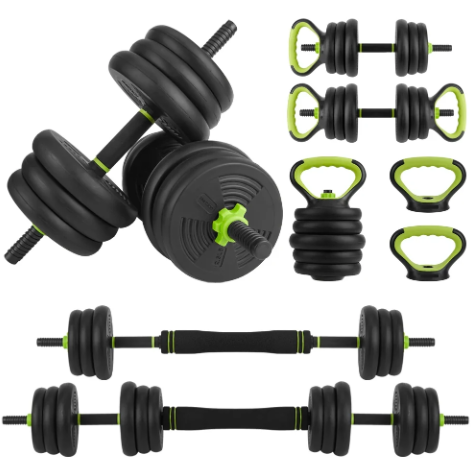
Dumbbells are probably the most versatile tool in any home or commercial gym. They allow unilateral training, which helps correct muscle imbalances that bilateral lifts like barbell squats can mask. Adjustable dumbbells save space and let you scale weight as you get stronger, which matters if you're training at home rather than a full facility.
Beyond dumbbells, a solid weight bench paired with a rack or cage opens up compound lifts—bench press, squats, overhead work—that build the kind of full-body strength no isolation exercise can match. If you're serious about progressive overload, a squat rack isn't optional; it's the safety net that lets you push heavier weight without a spotter.
Resistance Bands and Mobility Tools
Not everyone has room for a full weight rack, and that's fine. Resistance bands have become a staple for athletes who want strength benefits without the bulk. They're brilliant for activation work before a session, for rehab after an injury, and for adding variable resistance to bodyweight movements like squats and rows.
Bands also shine in areas free weights struggle with—rotational movements, lateral resistance, and joint-friendly strengthening for smaller muscle groups like the rotator cuff. Physical therapists have used them for decades for exactly this reason, according to research from the National Academy of Sports Medicine. Pair bands with handles for a better grip during pulling exercises, and you've got a portable gym that fits in a bag.
Cardio Equipment for Endurance and Conditioning
Sport-specific conditioning separates athletes who fade in the fourth quarter from those who finish strong. Treadmills remain a reliable option for controlled-pace running, interval training, and injury rehab where you need to manage impact carefully. Exercise bikes offer a lower-impact alternative that's easier on the knees while still torching cardiovascular fitness, which matters for anyone managing joint stress from a heavy training block.
Rowing machines deserve more attention than they usually get. They hit nearly every major muscle group in one motion, building both aerobic capacity and total-body strength simultaneously. If you want conditioning that doubles as strength work, rowing is hard to beat. According to the American Council on Exercise, rowing engages roughly 85% of the body's musculature per stroke, which is a pretty efficient use of training time.
Agility and Speed Training Tools
Strength gets you powerful. Agility gets you fast in the right direction at the right moment, which is what actually wins games. Agility ladders are a classic tool for footwork drills that build coordination, reaction time, and lateral quickness—skills that matter in soccer, basketball, and football alike.
Speed ladders work best when paired with cone drills and short sprints, creating a training circuit that mimics the stop-start nature of most field sports. Coaches often layer resistance—like a weighted vest or ankle straps—on top of ladder work once an athlete has the coordination down, adding a strength component to what's normally a pure speed drill.
Recovery and Support Equipment
Training hard without recovering properly is basically training yourself into an injury. Exercise mats are underrated here—they cushion joints during stretching, foam rolling, and mobility work, and a stable non-slip surface actually changes how confidently you move through a stretch or a core exercise.
Compression gear, like compression shirts and sleeves, has grown popular for a reason too. Some athletes report reduced muscle soreness and better circulation post-workout, though the science on this is still mixed according to a review published in Sports Medicine.
Either way, they're comfortable and low-risk to try. Wrist and ankle weights, hand grip strengtheners, and hamstring curl straps round out a recovery-and-support toolkit that keeps smaller muscle groups from becoming the weak link in your training chain.
Sport-Specific Equipment Considerations
Not every athlete needs the same setup. A golfer benefits far more from golf training aids than from a rowing machine. A basketball player might prioritize a weighted basketball for dribbling control over a treadmill session. Baseball players lean on batting tees, nets, and specialized gloves that build hand-eye coordination and swing mechanics specific to their sport.
This is where it pays to think about your actual competition demands rather than just grabbing whatever's trending. A store like 24 Hour Sport carries a wide range of sport-specific gear across categories like basketball, baseball, golf, and general fitness accessories, which makes it easier to find tools matched to your actual sport rather than settling for generic equipment.
Building a Balanced Training Setup
A smart setup doesn't mean buying everything at once. Start with the basics: a set of adjustable dumbbells, a couple of resistance bands, and a decent exercise mat. That trio alone covers strength, mobility, and recovery for most athletes starting out. As your training matures, layer in cardio equipment and sport-specific tools based on what your competition actually demands.
Budget matters too. You don't need commercial-grade machines to make real progress—consistency with modest equipment beats sporadic use of expensive gear every time. Focus on quality basics that'll hold up to regular use rather than chasing every new gadget that shows up in your feed.
FAQs
How much training equipment do I actually need to get started?
Not much. A pair of adjustable dumbbells, a resistance band set, and an exercise mat cover strength, mobility, and recovery basics for most sports. You can expand from there as your goals get more specific.
Are resistance bands as effective as free weights?
They serve different purposes. Bands are excellent for activation, rehab, and joint-friendly resistance, but free weights are still better for building maximal strength through heavy, progressive loading.
What's the best cardio machine for athletes?
It depends on your sport and joint health. Treadmills suit runners, bikes are gentler on joints, and rowing machines offer a strong combination of cardio and strength work in one motion.
Do I need sport-specific equipment or general fitness gear?
Both, ideally. General fitness equipment builds your base—strength, conditioning, mobility—while sport-specific tools sharpen the exact skills your competition demands.
Conclusion
Building athletic performance isn't about owning the flashiest gear in the gym—it's about matching the right tools to your sport, your goals, and your current level.
Strength equipment builds your foundation, resistance bands and mobility tools keep you moving well, cardio machines build the engine, and agility tools sharpen the skills that actually show up on game day. Start simple, stay consistent, and add pieces as your training demands grow. That approach beats any shortcut, every single time.